
The diagnosis is yours. Everything around it doesn’t have to be.
Cogit is Voicebrook’s co-intelligence assistant, focused on the pathologist’s case review. It removes the searching, the remembering, the re-reading, and the assembling: the work that sits on either side of the diagnostic moment and competes with it for attention.
A report comes out of that. It is not what the product is for.
This is computational co-intelligence: systems that make pathologists better at what only pathologists can do, rather than attempting to do it for them.
Pathology doesn’t suffer from a lack of information. It suffers from fragmentation.
Pathologists are handed cases with almost no context, and the diagnostic work is surrounded on both sides by work that isn’t diagnostic.
The search before the diagnosis is slow, but the worst cost is ambiguity — the absence of a prior finding is itself meaningful, so the pathologist checks multiple places for multiple things and then double-checks the ones that came back empty.
None of this requires a pathologist’s training. All of it consumes a pathologist’s attention. The cost isn’t only time — it’s that the attention spent here is attention not spent on the slide.
What Cogit does, at each point in the case.
The clinical context is already assembled.
The protocol is tracked as the case unfolds.
The report is built out of the conversation you were already having.
The pathologist analyzes, Cogit organizes.
What changes on every case.
Preparedness
“When I start a case, the clinical context is immediately clear and apparent, so the questions that normally lead to searching across systems never come up.”
Confidence
“I know the information in my reports is clear and accurate without having to re-read or double check.”
Focus
“My time, attention, and mental energy are focused where I am most valuable — slide interpretation, diagnostic judgment, and therapeutic guidance.”
What stays yours.
Each of these is a deliberate design decision, and together they are what make everything else here trustworthy.
The read stays yours
The interpretation is the part of this job that belongs to a pathologist. Cogit does everything that surrounds it — no image interpretation, no suggested diagnosis.
The words stay yours
What you say routes the workflow and shapes the report. Cogit never decides what you should conclude.
Every value is yours to confirm
Each generated element is editable, and every derived value — staging included — is presented for your confirmation rather than applied silently.
Your systems stay your systems
Your LIS, your EHR and your imaging stay exactly as they are. Cogit works across them.
Cogit gives the pathologist everything they need to interpret the case — and then gets out of the way.
You can see how it got there.
Every piece of context is labeled with where it came from. What was chosen to show you is visible, and so is what was left in the source. And what Cogit understood from your own words appears as you speak.
Nothing is asserted without its basis.
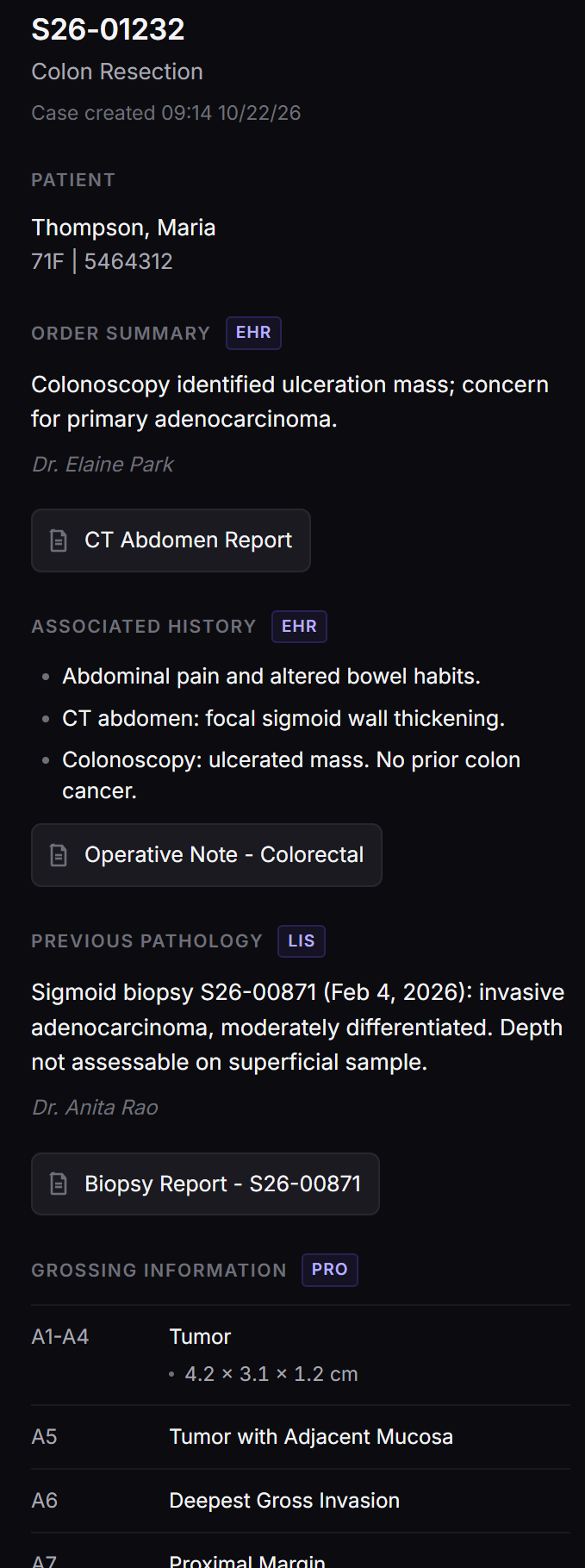
The case opens with the clinical picture already assembled: why this case exists, what the prior biopsy found, what was measured at the bench. Each block carries its source — EHR for the order and the associated history, LIS for the prior pathology, and PRO for the grossing detail.
A pathologist deciding how much weight to give a summarized finding needs to know where it came from. A system that presents assembled context without attribution is asking to be trusted rather than earning it.
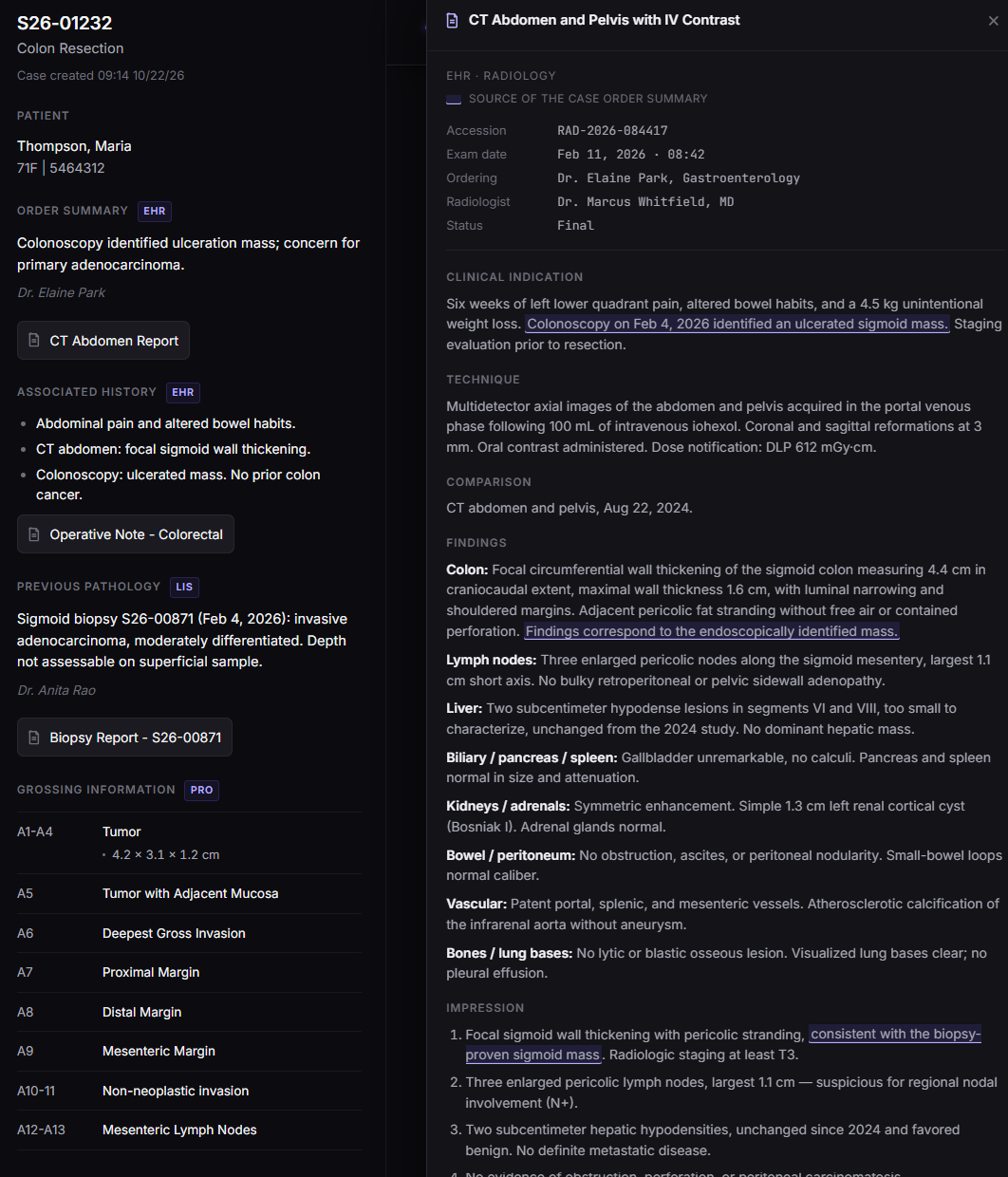
And you can see why it’s there.
Before any of that appears, something has already decided which documents matter to this case and which parts of them are worth putting in front of you. That decision is visible: a summarized finding shows the passages it drew on, and the full document opens in place.
Without it, working out whether a relevant report even exists is its own task — before anyone has read a word of it.
You speak, and two things happen at once.
Each sentence is analyzed the moment it commits. The clinical entities Cogit understood appear beneath it — and the protocol checklist fills in at the same time. One sentence, two visible consequences.
Reword or remove a sentence and the annotation is redone, so what Cogit understands always reflects the current text rather than the original transcript.
A chatbot waits to be asked. A transcription tool writes down what you said. Neither changes the state of the case because of what you said.
The protocol itself follows the diagnosis. As the case becomes colorectal adenocarcinoma, the criteria for colorectal adenocarcinoma are what gets tracked — because the link is the diagnosis code, not the protocol source.
Conflicts surface before the report does.
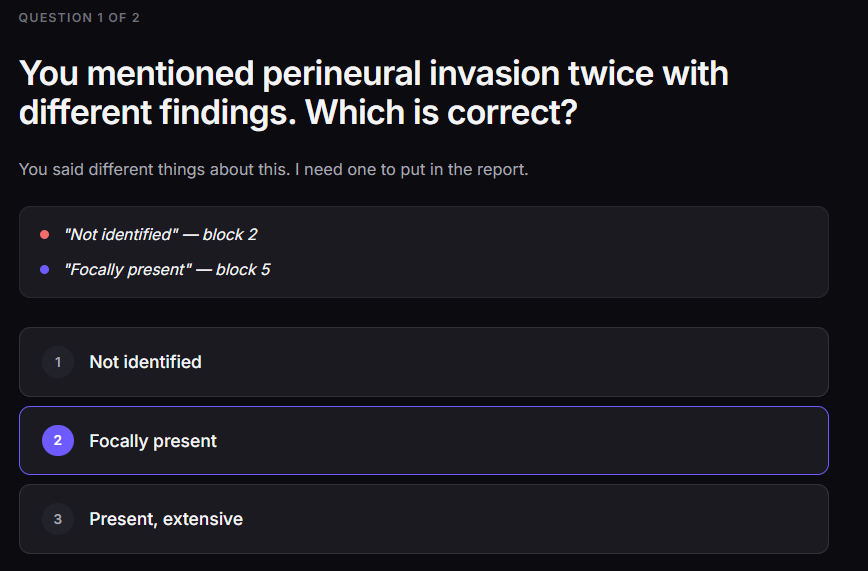
Perineural invasion described as absent at one block and focally present at another is caught before it reaches a report, not after. Both statements are shown with the block each came from.
Catching that today means noticing it yourself, on the reread.
And the pathologist answers it. The question is which finding is correct — never what the finding should be.
Adjust anything. It stays structured.
The synoptic is filled in from what was said, and every value stays yours to change — required and optional marked, completeness counted per section. Change one and it is still a discrete value, not a sentence someone has to parse back out later.
And it is not only the synoptic. The report itself is editable — narrative and structured fields open together, in one place — right up until it is submitted to the LIS.
Getting the report where it needs to go is the part we have been doing for two decades. 20+ AP-system integrations, and a home-grown system is not an exception. No interface project needed.
And because every value stayed discrete, the structured data is there with its metadata whenever something downstream needs it: an HL7 feed, a cancer registry, a system you haven’t chosen yet.
An interface makes that better. It was never the price of entry.
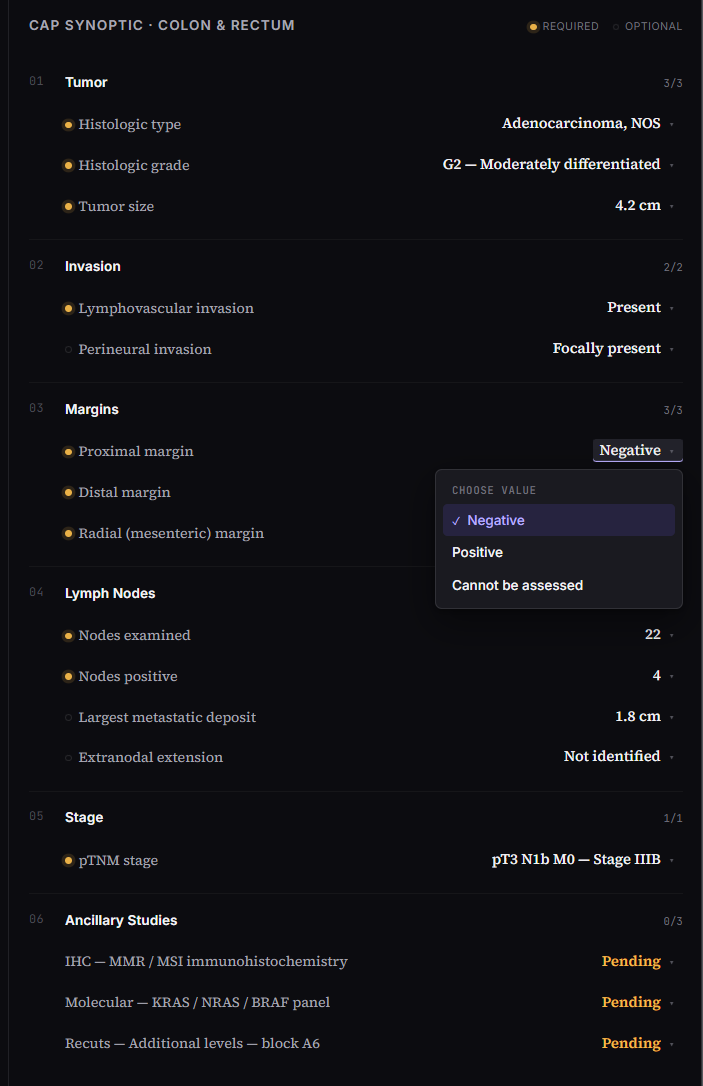
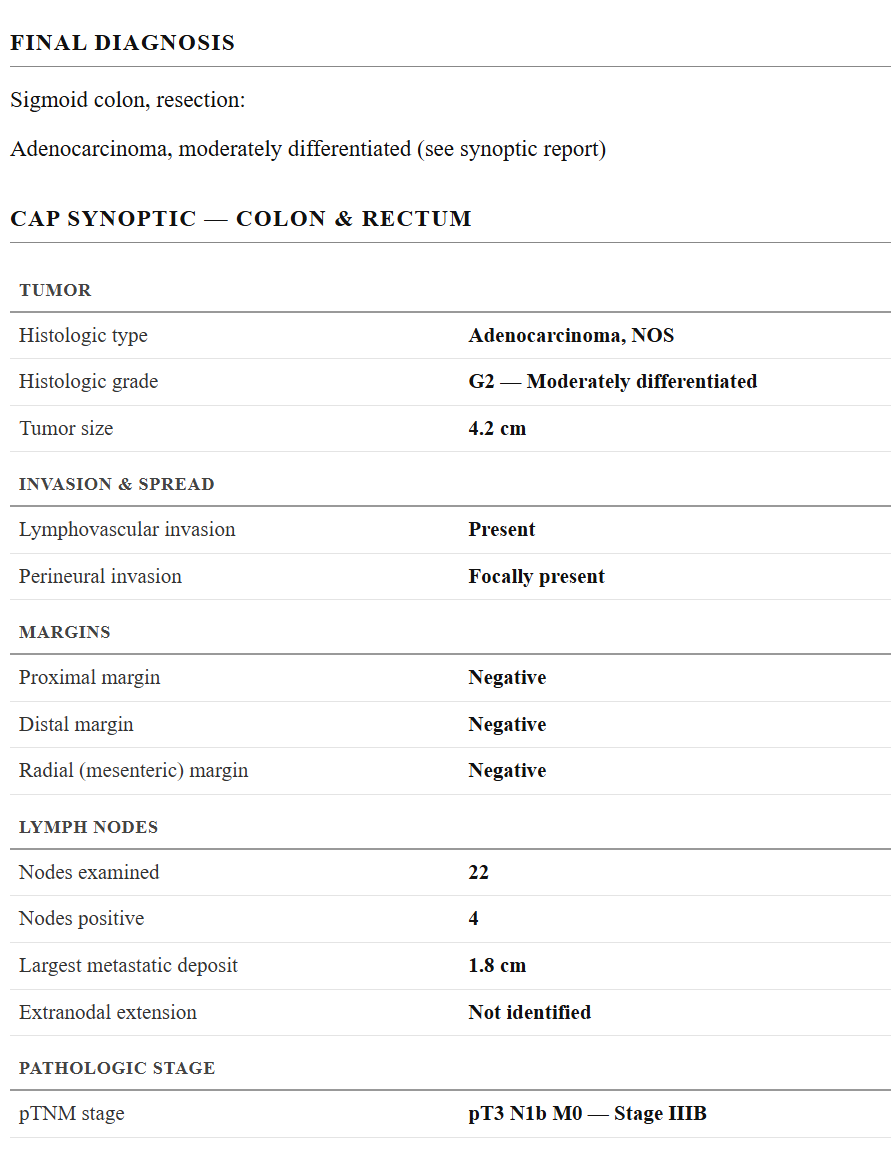
Staging is derived rather than asked for. It is a summary of what the pathologist has already said elsewhere, so asking separately is asking twice. The stage is calculated and then presented for confirmation — the question is whether it is correct, not what the answer should be.
Simple cases stay simple. A routine biopsy handled today in a single spoken phrase is never more work than it was before.
A derived value offered without justification asks for trust. A derived value offered with its basis invites judgment — which is the only version a pathologist should accept.
Every claim traces to something demonstrable.
Across fifteen body-system categories, from Breast and Central Nervous System through Skin and Thorax. Every tenant starts with the full set seeded.
The link is the diagnosis code, not the protocol source. CAP protocols come pre-built and pre-linked; a hospital's own protocol, a specialty society's, or one we author participates the same way.
Conflicts, ambiguity, and unaddressed items are surfaced before a report is generated. Perineural invasion described as absent in one place and focally present in another is caught before it reaches a report.
An addendum carries the ancillary findings, not a restatement of the original checklist. Duplicating a checklist across two reports creates divergence, and divergence in a synoptic can affect treatment.
When the pathologist calls for MMR, KRAS, or BRAF while working the case, the order goes into the LIS. They don't finish the case and then go somewhere else to order what they just asked for.
Go live without waiting on an interface project. Integrations deepen the available context, and depth is the point — most capabilities work without them.
The pressures this is pointed at.
The case for computational co-intelligence in a department is not that it saves time on a case. It is that the pressures below are not answerable by hiring.
Anatomic pathology carries the highest overall vacancy rate of any laboratory department. Filling an AP supervisory vacancy takes more than twelve months.
Laboratory staff, not pathologists.
ASCP 2024 Vacancy Survey — Garcia et al., Am J Clin Pathol 164:759, November 2025
CAP allows roughly eight months from a protocol's posting before a laboratory is exposed to deficiency risk at inspection. Protocols are revised continuously, so the obligation resets rather than completing — and the response to a finding has the chair's name on it.
Protocol currency is a standing burden, not a one-time project.
CAP protocol currency requirements
Pathologist supply is projected to decline 7% against a 16% increase in demand by 2037 — roughly 3,000 more pathologists needed, against about 600 entering the profession each year.
The argument is not that we save time. It's that hiring is not an available answer.
ASCP, September 2025 (Edna Garcia), citing HRSA projections
Joined at the seam, by design.
VoiceOver PRO® handles the grossing workflow. Cogit handles case review.
The grossing detail flows into Cogit without anyone restating it — what is on each slide, which sections came from the tumor, the measurements taken at the bench, arriving labeled as coming from PRO.
With PRO you dictate the report. With Cogit you talk through the case, and the report is assembled from it.
Tell us what your pathologists need.
This is being built against real practice rather than against assumptions about it. Strategic Partners get first access to the Beta in late 2026, seats on the Reference Advisory Committee, and direct input into what gets built next.
We ask for active participation in shaping it. You become a design partner, not just a customer.